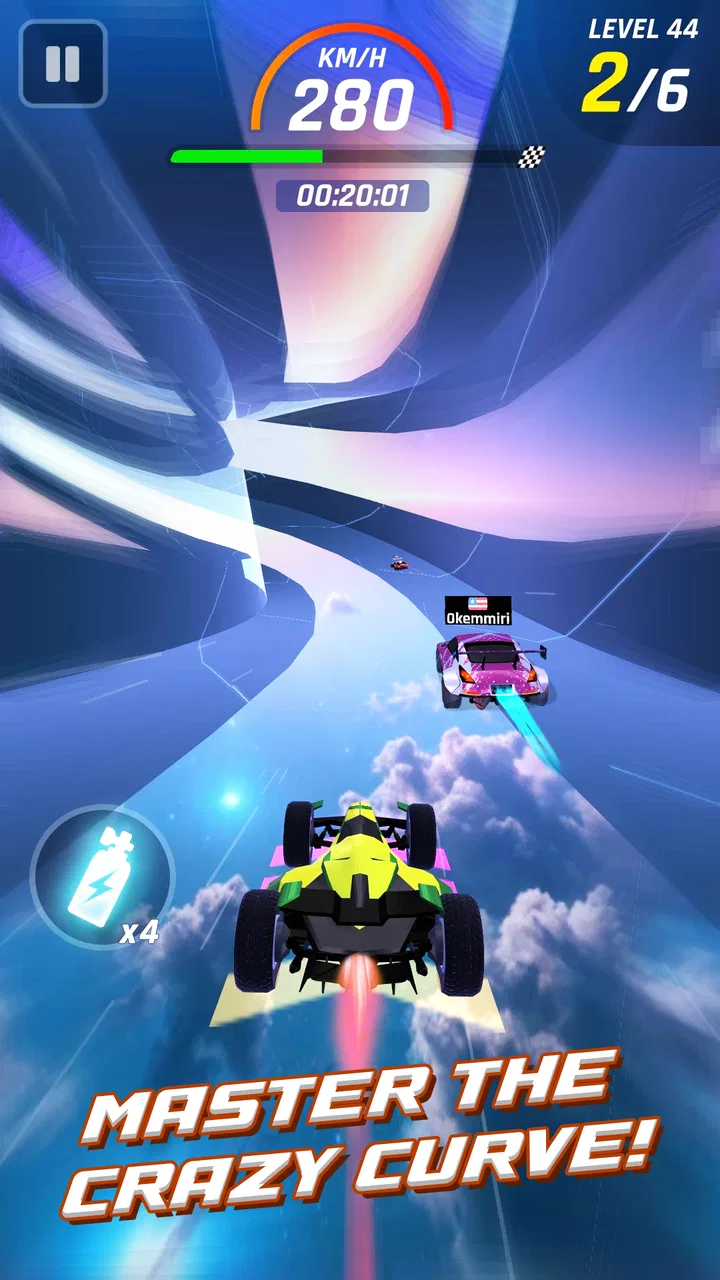
Car Rush 3D: Speed Legend
- 4.5
- Rating
- 10.00M
- Installs
- Free
- Price

 Analysis by App-foxy
Car Rush 3D: Speed Legend is the kind of mobile racing game I can open for a quick break without needing to learn a complicated control system first. It comes from Wayfu Studio, is free to download, and is aimed at Everyone, so its general presentation is easy to approach. I found the appeal in its directness: the game wants me to get moving, react quickly, and improve through repeated attempts rather than spend a long time preparing a car or studying a large menu.
That simplicity makes it a useful choice for short sessions, especially when I want arcade-style racing rather than a serious driving simulator. It is available on Android devices running at least Android 7.1, and the current version is 1.86. The game has already passed ten million installs and holds an average rating of 4.5 from around eleven thousand ratings, which suggests that its straightforward format has found a sizeable audience.
What the first race feels like
My advice to a new player is to treat the opening session as a learning lap, not a test of skill. The store summary talks about mastering speed, but the practical experience is less about driving realistically and more about understanding the rhythm of an arcade race. I focus on what appears immediately in front of me, make small corrections instead of dramatic movements, and avoid trying to play perfectly from the first attempt.
You May Also Like

 Blood Strike: 2.5 Anniversary
Blood Strike’s Loadouts Turn Every Drop Into a Tactical Gamble
A close look at Blood Strike’s custom loadouts: how fast access to signature weapons reshapes its battle royale rhythm, rewards preparation, and narrows the gap between fights.

 Pandora - Music & Podcasts
Pandora’s Music Is Easy to Start, but Harder to Recover
Pandora’s strength is its low-effort path from a seed to a station. Its weak spot is how much confidence it asks you to place in connection, setup, and quiet recovery.

 8 Ball Pool
 Is Built on Rivalries, Rematches, and Routine
A close look at the rivalries, rematches, shared routines, and unanswered safety questions that turn a quick pool match into a persistent mobile community.

 Samsung Music
’s Quiet Strength Is Playing What You Already Own
Its reach comes less from spectacle than from dependable access to a personal library. That simplicity is both the app’s strongest retention engine and its ceiling.

 AccuWeather: Weather Radar
AccuWeather Review: A Quick, Clear Forecast for Everyday Decisions
For everyday plans, the best forecast is the one you can understand quickly. AccuWeather makes rain timing, radar, and local conditions easy to act on, with a few trade-offs.

 Hill Climb Racing
Why Hill Climb Racing Still Turns Crashes Into One More Run
A tiny car, a bumpy hill and one more upgrade: Hill Climb Racing keeps resurfacing because its simple chaos makes every near-miss feel personal.
More From Our News Desk



The short description calls it Car Rush 3D, and that name sets the right expectation. This is not the sort of racing game I would choose for detailed car ownership, deep tuning, or a long career narrative. Its strength is the quick loop: start a run, respond to the road, see how far my decisions take me, and try again with a better sense of timing.
That makes the game particularly comfortable for a first-time user. I do not need to understand every option before beginning. I can start with the basic driving challenge, watch how the car responds, and gradually work out which movements are safe. A useful early habit is to keep my attention on the next obstacle or turn instead of looking too far ahead. Mobile screens are small, and overcorrecting usually creates more trouble than reacting calmly.
The 3D presentation also changes how I judge distance. Objects can appear closer or farther away than expected while the car is moving, so I prefer controlled inputs over constant tapping. When a run goes wrong, I try to identify whether I turned too early, waited too long, or simply reacted to the wrong visual cue. That small review after each attempt is more valuable than rushing straight into another run without changing anything.
Setting up without overthinking it
Because the game is free, the first decision is not whether to buy it but whether its style matches what I want from a racing game. I would install it for quick arcade sessions, casual competition with myself, or a simple way to fill a few spare minutes. I would not choose it as a replacement for a realistic racer with licensed vehicles, detailed physics, or extensive customization.
The age rating of Everyone makes it easy to consider for a broad audience, but that does not mean every player will enjoy the same pace. Someone who likes fast reactions and repeated attempts may settle in quickly. Someone who prefers slow exploration or precise simulation may find the experience too immediate. I think that distinction matters more than the rating when deciding whether to keep it installed.
On my first launch, I recommend checking the available menus before beginning a serious attempt, but not spending too long there. Look for the obvious starting route, note whether the game introduces any controls or objectives, and then begin. The best setup is usually practical: hold the phone comfortably, keep the screen clear, and make sure I am not trying to play while distracted by notifications or a crowded commute.
There is also a financial point worth noticing. The game itself is free, while optional in-app purchases range from $1.99 to $29.99 per item. I would not spend anything during the first session. A new player needs time to decide whether the driving loop is enjoyable before considering optional purchases. If I later choose to buy something, I would first identify exactly what it changes and whether it improves my experience rather than simply helping me skip a frustrating moment.
This is one of the more important practical tips for a free racing game: do not confuse faster progress with better value. If the basic controls are not enjoyable, purchasing an advantage will not fix that. I would play several short sessions first, learn the handling, and only then decide whether any optional item fits the way I use the game.
How to reach the first meaningful success
For me, the first meaningful success is not finishing with an impressive result. It is completing a run while staying in control for longer than the first attempt. That gives me a clear target and removes unnecessary pressure. I start by making deliberate movements, leaving room for correction, and resisting the urge to chase every possible opportunity at once.
A simple three-step routine works well. First, observe the opening section and notice how quickly the car responds. Second, use the next attempt to change only one thing, such as turning earlier or holding a steadier line. Third, repeat that adjustment long enough to decide whether it helped. Changing several habits at once makes it difficult to understand why a run improved or failed.
When I finally complete a clean section, I treat that as useful information rather than luck. I remember the visual cue that came before the successful movement and try to reproduce it. This is a small but effective way to build consistency in a game that rewards quick reactions. It also prevents the common beginner mistake of playing every attempt as if it were completely new.
Another practical tip is to use short practice blocks. I would play for a few minutes, stop briefly, and then return with a clearer head. Racing games can make me press harder or move faster when I become frustrated, but that usually reduces accuracy. A short pause helps me separate a genuine control problem from a rushed decision.
For an everyday scenario, imagine waiting for a bus or taking a short break between tasks. Car Rush 3D: Speed Legend fits that moment better than a large racing game that expects a long uninterrupted session. I can make a few attempts, learn one section, and put the phone away. The same quality can become a limitation if I want a deep evening game with a strong sense of long-term progression.
Where new players may become confused
The biggest source of confusion is likely to be expectation. The word “racing” can suggest a full competition against several opponents, complex vehicle statistics, or a structured championship. I approach this title more as a fast arcade driving challenge. That mindset makes the simple presentation feel intentional instead of incomplete.
Another possible stumbling block is judging why a run failed. A crash or missed movement can feel random when I am watching the car rather than the road pattern. I solve this by replaying the moment mentally: was my input too large, did I react to an object that was not actually in my path, or did I wait until the last safe moment? This kind of diagnosis is more useful than blaming the game after every mistake.
New players may also wonder whether they should immediately pursue the highest possible result. I would avoid that at first. Early consistency matters more than a risky attempt that succeeds only occasionally. Once I can handle the opening portion comfortably, I can start experimenting with faster decisions. The trade-off is clear: safer play builds understanding, while aggressive play may produce a better result but also teaches less when it fails instantly.
The free-to-play structure can create a second kind of uncertainty. Since optional purchases are present, I would pay attention to whether a difficult moment is asking me to improve my timing or inviting me to spend. Those are not the same thing. My preferred workflow is to retry normally, adjust my approach, and only consider a purchase if I already enjoy the core game and understand its purpose.
Device age is another practical consideration. The minimum operating system is Android 7.1, so users on older Android versions will not have the same starting point. On a compatible phone, I would close demanding background apps if the game feels less responsive than expected. I would not assume that a newer version number automatically means every older device will perform identically; racing depends heavily on clear visual feedback and responsive input.
The version number, 1.86, is useful when checking whether the installed copy is current, especially if the game behaves differently from what I remember. I would update through the normal app store process before troubleshooting a control issue. That does not guarantee a particular result on every device, but it is a sensible first step before changing habits or blaming the hardware.
How it compares with other mobile racing choices
Compared with simulation-focused racers, this game is easier to approach and less demanding in terms of preparation. I do not need to think like a mechanic or learn a detailed braking model before having a worthwhile attempt. That is a genuine advantage for casual players, younger users, and anyone who wants immediate action.
Compared with large arcade racers, the attraction is the compact commitment. Bigger alternatives often offer more systems, more visual spectacle, or a broader sense of progression, but they can also require more storage, more time, and more attention. I would choose Car Rush 3D: Speed Legend when I want the driving challenge itself to be the main event rather than a small part of a much larger package.
The trade-off is depth. If my ideal racing game includes extensive car collections, detailed tuning, a story, online rivalry, or a carefully structured campaign, I would look elsewhere. This title makes more sense when I value a fast start and repeated skill improvement. It is not a weakness that it avoids simulation complexity, but it does mean the game may feel limited once I have exhausted the appeal of its central loop.
The rating of 4.5 and the audience of over ten million installs make it easier to recommend as a game worth trying, but I would still keep the recommendation specific. Popularity does not turn a casual racer into a deep one. I see those figures as evidence that the format works for many people, not as a reason to ignore whether my own preferences match it.
The next step after the first few sessions
After I understand the basic movement, I stop treating each attempt as a separate event and start building a repeatable routine. I use the same comfortable grip, keep my attention near the next decision point, and change one technique at a time. This turns the game from a reflex test into a small practice exercise, which is where I find its most satisfying quality.
I also recommend setting a personal goal that does not depend on a leaderboard or a purchase. It could be surviving a difficult section, completing a run with fewer mistakes, or improving consistency over several attempts. These goals are easier to measure honestly and keep the game enjoyable when progress slows.
If the game feels too easy after a while, I would increase the challenge through cleaner decisions rather than simply playing faster. Try taking fewer unnecessary risks, reacting later but more accurately, or maintaining control through a longer sequence. If it feels too difficult, return to the opening area and focus on recognizing visual patterns. The same game can feel very different depending on whether I chase speed or stability.
I would skip this title if I need a long-form racing experience with detailed realism, a substantial narrative, or a large social component. I would also skip it if repeated short attempts feel frustrating rather than satisfying. In those situations, a more structured racer may offer better value even if it takes longer to learn.
For everyone else, the low-risk starting point is its strongest argument: it is free, approachable, and quick to test. Install it, give the first few runs your full attention, and decide based on how much you enjoy improving your control. The best reason to keep it is not the promise of speed, but the satisfaction of turning one messy attempt into a clean, repeatable run.
My final view is positive but measured. Wayfu Studio has made a racing game that works best as an accessible arcade break, not as a substitute for a full driving simulator. The current version is 1.86, the game is free with optional purchases, and its Everyone rating broadens its appeal. I would recommend it to a friend who wants immediate mobile racing and does not need a complicated progression system. I would explain the limitations honestly, then suggest starting slowly, learning the response, and judging the game by that first successful stretch of controlled driving.
FAQs for Car Rush 3D: Speed Legend
01What is Car Rush 3D: Speed Legend?
Car Rush 3D: Speed Legend is an exhilarating racing game available for both Android and iOS devices. It offers players a thrilling experience with high-speed races, stunning graphics, and a variety of challenging tracks. The game focuses on delivering an adrenaline-pumping adventure through diverse environments and customizable cars.
02What features does Car Rush 3D: Speed Legend offer?
Car Rush 3D: Speed Legend includes several engaging features such as a wide selection of cars, customizable upgrades, multiple game modes, and immersive 3D graphics. Players can enjoy time trials, competitive races, and exploration of unique tracks. The game also offers leaderboards and achievements to enhance competitiveness.
03Is Car Rush 3D: Speed Legend free to play?
Yes, Car Rush 3D: Speed Legend is free to download and play. However, it may include in-app purchases for players who wish to accelerate their progress or acquire special items. These purchases are optional, and the game can be fully enjoyed without spending money.
04Does Car Rush 3D: Speed Legend require an internet connection?
Car Rush 3D: Speed Legend can be played offline, allowing players to enjoy races without an internet connection. However, certain features like leaderboards and multiplayer modes may require online access to function. Offline play is perfect for players who want to enjoy the game on the go.
05Is Car Rush 3D: Speed Legend suitable for all ages?
Car Rush 3D: Speed Legend is designed to be enjoyed by players of all ages. It features intuitive controls and engaging gameplay that is accessible to both younger and older audiences. However, parental guidance is recommended for in-app purchases to prevent unintended transactions.
Pros
- Stunning graphics enhance gameplay experience.
- Smooth controls for precise handling.
- Variety of cars and tracks to unlock.
- Engaging multiplayer mode available.
- Regular updates with new features.
Cons
- In-app purchases can be pricey.
- Some ads disrupt gameplay flow.
- Limited customization options for cars.
- Battery consumption is relatively high.
- Requires stable internet for multiplayer.

Car Rush 3D: Speed Legend
Gallery